








At the University of Leeds, School of Design, an innovative facility is redefining how waterproof garments are tested. The recently updated Rain Room has been designed to simulate real-world weather conditions, offering new insights into how clothing performs under sustained rainfall.
By recreating everything from heavy downpours to fine drizzle, the Rain Room allows researchers and brands to better understand how garments respond to wet conditions. This kind of testing is increasingly important as consumers demand higher-performing, longer-lasting, and more sustainable clothing.
Testing for Real-World Conditions
Traditional waterproof testing often relies on standardised laboratory methods that cannot fully replicate the complexity of natural rainfall. The Rain Room addresses this by producing a range of droplet sizes and intensities, including the persistent light drizzle commonly experienced in the UK.
This finer rain is particularly effective at revealing weaknesses in garments. Rather than simply bouncing off the surface, it can sit on the fabric and gradually work its way through tiny imperfections in seams, stitching, or the material itself. As a result, researchers can identify issues that might otherwise go unnoticed in more conventional tests.
“We have everything from the large raindrops that you might get in a cloud burst to a very fine drizzle. This drizzle is very good at finding its way through any faults in garments because it sits on the fabric surface, and when it gets the opportunity, it can move along the fabric surface, and it can find weaknesses in threads and seams.”
Dr Mark Taylor
Research Fellow in Sport Clothing and Sustainability at the School of Design
Garment Performance
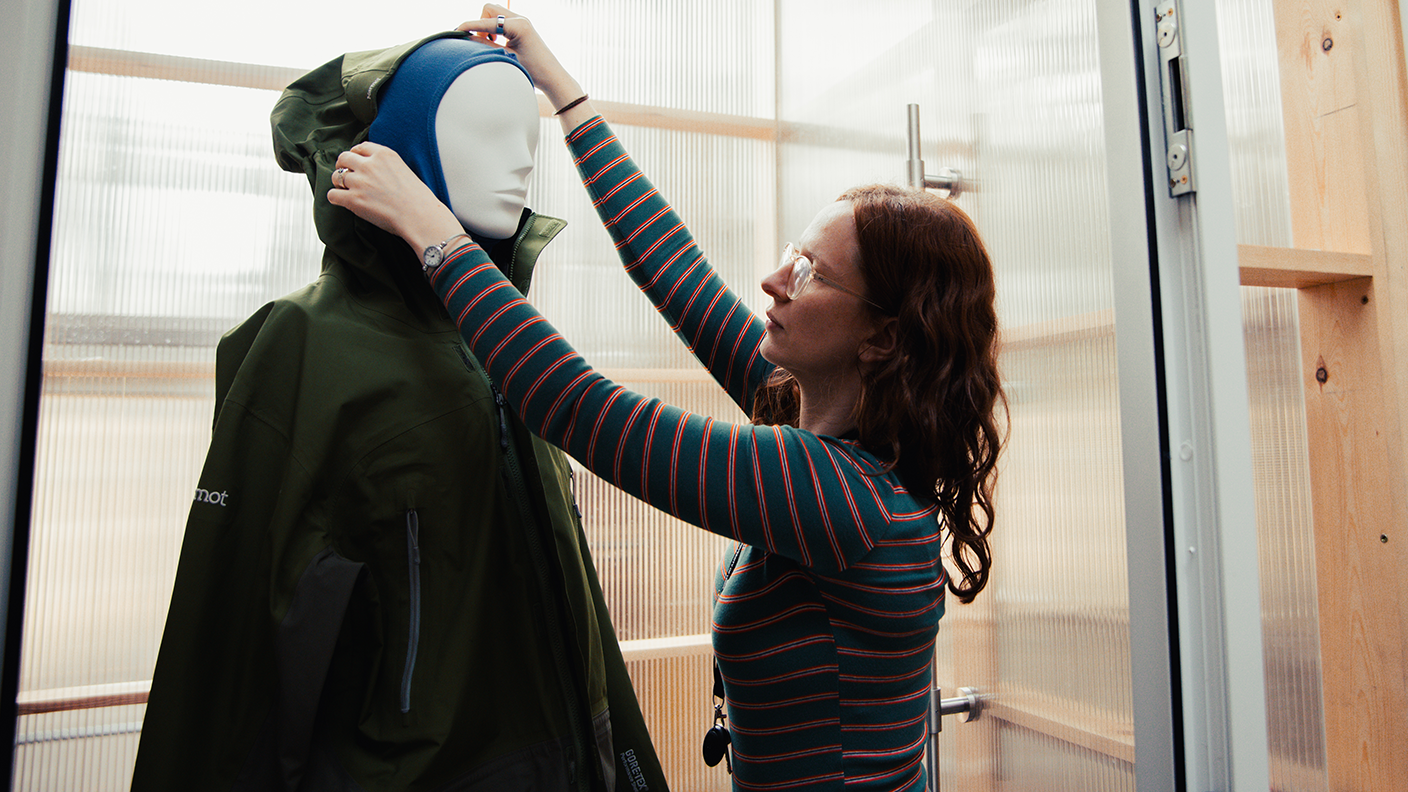
During testing, garments are placed on a rotating mannequin that mimics natural human movement. Over a four-hour cycle, the garments are exposed to continuous rainfall, ensuring that all areas are tested thoroughly.
Instead of relying solely on automated sensors, researchers also use a more hands-on approach. Absorbent layers worn beneath the outer garment help pinpoint exactly where water begins to penetrate. This method provides detailed, practical insights into how and why a garment may fail, supporting improvements in both design and construction.
Designed with Sustainability in Mind
Alongside its technical capabilities, the Rain Room reflects a growing emphasis on sustainability within the textiles industry. The updated system recirculates water within a self-contained setup, significantly reducing waste compared to earlier designs.
This approach mirrors wider industry efforts to minimise environmental impact while maintaining high standards of performance and testing accuracy.
Supporting Industry Innovation
The Rain Room has already played a key role in shaping waterproofing standards for major outdoor apparel brands. By subjecting garments to rainfall intensities of up to 15 mm per hour, about five times those in typical UK conditions, the School of Design generates robust, real-world performance data that supports product development.
More broadly, the facility represents a significant step forward in textile testing. By providing precise, actionable insights, it enables brands to refine designs, improve durability, and respond to evolving consumer expectations. In doing so, it reflects the increasingly technical nature of modern garment development, where materials science, engineering, and sustainability considerations converge.
Explore Performance Clothing at the University of Leeds
For those interested in exploring this field further, the principles underpinning facilities like the Rain Room form part of a wider approach to performance clothing and textile testing. Understanding how fabrics behave under stress, how construction materials and techniques influence durability, and how testing informs innovation are all essential to developing effective garments.
At the University of Leeds, these concepts are brought to life through the Sports and Performance Clothing: From Fibres to Function course. Combining theory with practical insight, the course introduces methods for evaluating and enhancing garment performance, including demonstrations of testing in action.
It offers a clear pathway into the science of performance textiles, exploring how functional clothing works, why it matters, and how material choices impact real-world use. Through a blend of technical knowledge and applied learning, participants gain the tools to develop high-performing, durable, and purpose-driven garments.